Building a Global Game: APP Asia Tour Leaders Reflect on a Breakthrough Year in Malaysia
Marc Chua, Yui See Lau, Yuki Chen and Caryn Yap discuss the success of the APP Asia Tour in 2026

APP
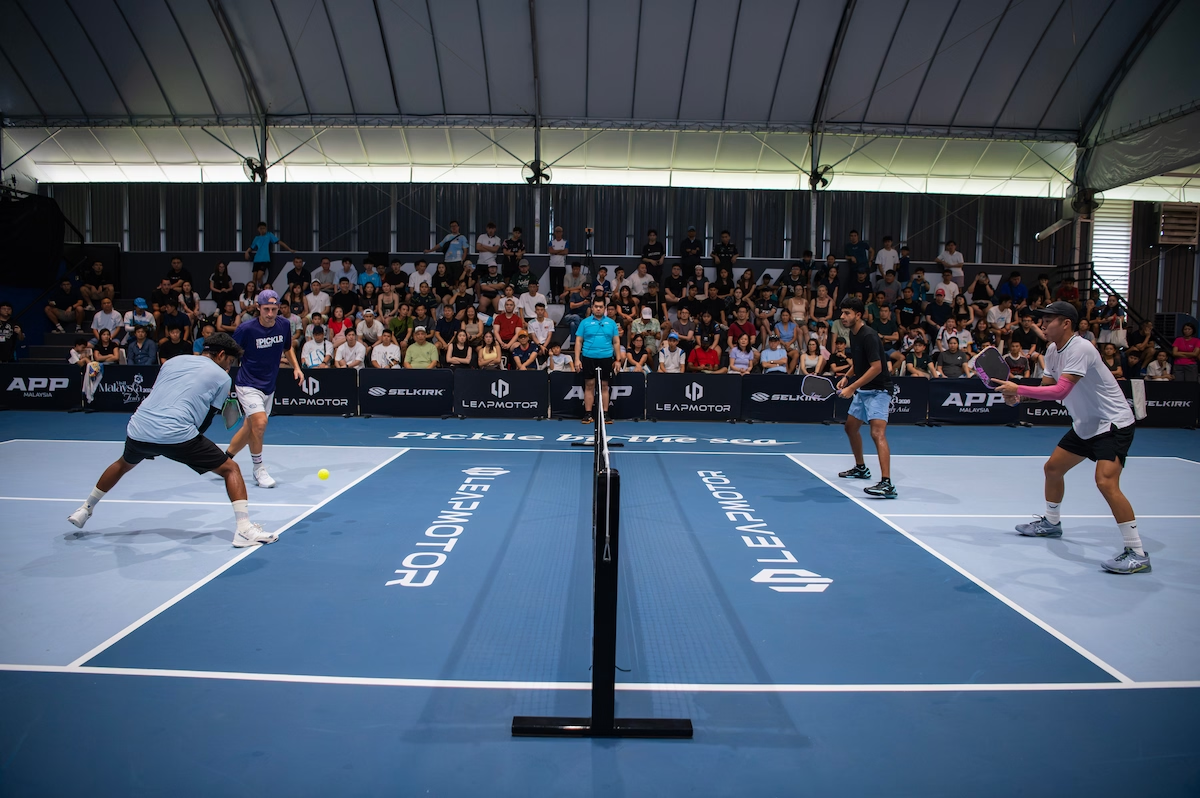
The APP Asia Tour made a significant entrance into Malaysia in 2026, bringing world-class pickleball competition to Kuala Lumpur and Penang while connecting professionals, amateurs and junior players from across Asia and beyond. In February, the Leapmotor APP Kuala Lumpur Open recorded 1,760 player participations from 28 countries, and July's Leapmotor APP Asia Penang Open continued the momentum with 1,386 participations from 22 countries.
Following those landmark events, APP Asia leaders Marc Chua, Caryn Yap, Yui See Lau and Yuki Chen sat down to reflect on the tour’s early success, the distinctive growth of pickleball across Asia and the work ahead as stewards of pickleball's first truly global professional ecosystem.
Now that the dust has settled on the Kuala Lumpur and Penang events, have you had a chance to catch your breath?
Marc Chua: Not really! Kuala Lumpur and Penang were important milestones for us, but in many ways, they were just the beginning. We launched the APP Asia Tour this year with a clear ambition to build a genuine regional tour, and after Malaysia, our attention immediately shifted toward expanding into other markets across Asia.
There has not been much time to stop, but it has been rewarding to look back and see how much we have managed to build in a relatively short period.
Yui See Lau: Same here, not really—and I think that is a good thing.
For me, Kuala Lumpur and Penang were not the finish line. They were proof of concept. We wanted to see what would happen if we brought the APP experience to Asia at a genuinely international level, and the response gave us a clear answer.
The most exciting part is what comes next. We are taking everything we learned in Malaysia and determining how to apply it to very different markets across Asia. Every country has its own culture, sporting ecosystem and way of consuming sports. That presents a fascinating challenge—and opportunity.
Caryn Yap: I was so looking forward to having a breather, but we have more exciting stops coming up for the APP Asia Tour and the real work starts now.
Yuki Chen: Not really — and I don’t think we should yet. Kuala Lumpur and Penang proved that the APP standard can work in Asia. The real work now is turning those two events into a repeatable Asia tour operating system: consistent rules, officiating, ranking, data, player services, sponsorship delivery, and local partner enablement. We are not catching our breath; we are building the platform.
What are your favorite takeaways or memories from the two events? What made them so successful?
Marc Chua: My biggest takeaway was seeing how strongly the APP brand was received in Asia.
Kuala Lumpur represented the APP’s inaugural brand entrance into the Asian market, so we knew we had one opportunity to make a strong first impression. The APP has built a longstanding reputation in the United States, and many players and pickleball followers across Asia had already heard of the brand and followed its events and athletes from afar.
Malaysia was the first time many of them could experience the APP in person—and, most importantly, compete alongside and interact with APP players. That was very special to see. Suddenly, something they had previously watched online from the other side of the world was happening on their own doorstep.
Yui See Lau: Similarly, the thing I probably enjoyed most was watching the APP brand become real for people.
There is a huge difference between following professional pickleball on Instagram or YouTube and suddenly having those players standing on the court next to you, watching your match, playing against you or simply spending time around the venue. That creates a completely different emotional connection.
Caryn Yap: I think the one thing that sets us apart from other tournaments is the community and vibes that we can bring to the table. Instead of only focusing on ensuring the tournament is well run, we actually put more effort into creating activations that we could engage players in while they’re off court.
This is something I personally love to create as it is the fun part of my job. I would love to be able place focus and effort on creating more fun social activities to run throughout the event. As a matter of fact, I’ve just created a social tournament game that goes against all the traditional rules of pickleball. Do keep a look out of it in Asia!
Yuki Chen: My strongest takeaway is that APP’s international credibility and Asia’s local energy can coexist. What made them successful was not just the number of players or countries. It was that local clubs, partners, volunteers, and international players all felt ownership of the event. The memory I value most is seeing professionals, amateurs, and juniors in the same environment — but we care more about codifying that into a repeatable model than romanticizing the moment.
Marc Chua: We also wanted the events to feel genuinely international from day one. The Kuala Lumpur Open welcomed 1,760 player participations, including 711 international participations from 28 countries. Penang continued that momentum with 1,386 participations representing 22 countries and more than 100 players competing in the professional divisions.
Beyond the numbers, one of my favorite memories was seeing professionals, amateurs and juniors from across Asia and beyond sharing the same event environment. There was tremendous excitement around the APP players who traveled to Malaysia.
Yui See Lau: That’s right. Another thing that stood out most was the energy. People who had played pickleball for years, those who were relatively new to the sport, juniors, recreational players and serious professionals were all interacting within the same environment. There was a real sense that people understood something bigger was happening.
I think the events succeeded because they did not feel like something that had simply been imported into Malaysia. They had a strong local identity while maintaining the production value, professionalism and competitive credibility people associate with the APP.
That balance is very important. When we expand internationally, the answer is not to take an American event and simply reproduce it in another country. The goal is to retain the DNA of the APP while making the experience meaningful to the local market.
Marc Chua: The combination of the APP’s established international reputation, the opportunity for Asian players and fans to experience the brand firsthand, and the incredible support of our local community, partners and international participants made the events particularly successful. More importantly, they gave us a strong foundation for what we want to build across the rest of Asia.
How would you characterize the current state of pickleball in Malaysia and across Asia? Where are you seeing the strongest momentum?
Marc Chua: Asia is one of the most exciting growth markets for pickleball globally.
Malaysia has developed incredibly quickly. What started primarily as recreational participation is becoming a much more complete ecosystem, with dedicated facilities, tournaments, brands, sponsors, professional players and increasingly sophisticated event organizers.
Caryn Yap: It’s definitely growing like mushrooms! I think what every organizer is still worried about is how to maintain this sort of hype across Asia. For example in Vietnam, they are most likely right now sitting at a maturity to decline stage for tournament goers. A lot of players make their purchasing decision solely on how much the cash prize is or is it worth me spending this much on tickets where I might not be able to see a return?
Yui See Lau: I think we are at a very interesting inflection point.
For a long time, the conversation around Asian pickleball was essentially, “This is a huge potential market.” We are moving beyond the potential stage. In several countries, the infrastructure is beginning to catch up with the enthusiasm. Facilities are being built, communities are becoming organized, tournaments are getting bigger, brands are entering the market and players are beginning to see a legitimate competitive pathway.
However, I would not describe Asia as a single market. That is probably one of the biggest lessons I have learned.
Malaysia has its own trajectory. Vietnam is producing exceptional athletes. China has an enormous population and a deep existing racket-sport culture. India has extraordinary scale and a large youth population. Thailand, Taiwan, the Philippines and other markets are developing in their own ways.
Marc Chua: That's right. What's particularly exciting is that the momentum is not isolated to one country. We are seeing strong development across Southeast Asia, China, Taiwan, India and other parts of the region. Vietnam is producing some very strong professional players. Malaysia has an enormous participation base and rapidly growing infrastructure. China has tremendous long-term potential, while markets such as Thailand, Taiwan and India are developing quickly as well.
That is one of the reasons we created APP Asia as a tour rather than simply a collection of individual tournaments. We want players to have a pathway across countries and, ultimately, to connect Asian competition with the wider global APP platform.
Yui See Lau: There will not be one “Asian pickleball story.” There will be many individual stories that eventually connect to form a regional ecosystem. That is where APP Asia has an opportunity to make a difference—connecting those markets so players, fans, sponsors and media can see Asia as part of a larger professional pickleball landscape.
Yuki Chen: Asia is moving from “potential” to “institutionalization.” Malaysia is currently the benchmark for participation and event culture. Vietnam is a competitive engine. China is the long-term scale market. India has extraordinary youth potential. Thailand, Taiwan, the Philippines, Indonesia, and others are developing fast. The strongest momentum is where clubs, schools, commercial venues, and organizers connect. The biggest bottleneck is not interest — it is governance, officiating, facilities, and sustainable commercial models.
What has surprised you most about the way pickleball has developed differently across Asian countries?
Caryn Yap: I had never imagined that pickleball could grow in the speed it is growing at this stage. Hence my reference to mushrooms! I’ve spent my entire career surrounded in marketing products and services and I’ve never seen anything grow in this scale and that it even has a potential to stay centuries. And this all boils back down to communities.
If you speak to local Malaysian players, a lot of them would tell you they reconnected with their primary school mate or even kindergarten school mate after a long period of 20 years. That’s the beauty of the sport in Malaysia.
Marc Chua: Probably how different the pathway has been in each market. There is no single model for pickleball growth in Asia.
In some countries, growth is being driven by recreational communities and social play. In others, it is coming from established racket-sport athletes transitioning to pickleball. Some markets are developing through private clubs and commercial facilities, while others are being driven more heavily by associations and organized competition.
Yui See Lau: Similarly, you can walk into a pickleball community in Malaysia, Vietnam, China or India and recognize the sport immediately, but the ways people play it, socialize around it, organize it and consume it can be completely different.
That is partly because pickleball is building on top of deeply established racket-sport cultures. A badminton player may bring a very different set of instincts to pickleball than a tennis player. A table-tennis player might see angles and hands battles differently, while someone coming from a recreational background may approach the game differently again.
Marc Chua: That diversity is one of Asia’s biggest strengths. Rather than trying to make every market develop in exactly the same way, our job is to create a common competitive platform that connects them.
Yui See Lau: Precisely. We are not trying to make every country look like the United States. We are trying to create an international sport in which every market can contribute something culturally and athletically unique. The exciting question is what happens when all those influences begin interacting at the professional level.
Yuki Chen: The biggest surprise is not the speed — it is the divergence. Each market has a different entry point: community play, racket-sport conversion, private clubs, associations, or commercial venues. That means we cannot use a single Asian playbook. We need a modular platform: shared APP standards, ranking, brand, and global pathway, but local formats, pricing, partnerships, and cultural adaptation.
How is the APP Asia Tour helping pickleball become a truly global sport?
Marc Chua: For pickleball to become genuinely global, strong competitive ecosystems must exist outside North America. Players in Asia should not necessarily have to travel to the United States before they can experience a professional international tournament or begin building a pathway toward becoming professional players.
Our goal with APP Asia is to bring that infrastructure closer to them through international-standard tournaments, meaningful ranking opportunities, professional prize money, broadcast exposure and the chance to compete against leading players from around the world.
Yui See Lau: This is probably the part of the expansion that excites me most.
A sport does not become global simply because players from 30 countries attend an event. It becomes global when athletes can build careers in different parts of the world, fans have local stars to follow, sponsors see meaningful opportunities in those markets and the best players move internationally.
That is the ecosystem we are trying to build.
Marc Chua: At the same time, we want movement in both directions. We want American and European professionals competing in Asia, but we equally want Asian players to become recognizable international names and eventually compete successfully throughout the global APP ecosystem.
That is what makes a sport truly global: not simply having participants around the world, but creating credible pathways, events and stars in different regions.
Yuki Chen: APP Asia is not a satellite of North America. It is a second pillar. For pickleball to be truly global, players in Asia must be able to build careers without moving to the U.S., and American and European players must see Asia as a place to compete, earn, and grow. That requires regional rankings, prize money, broadcast, sponsorship, and two-way player movement. The goal is not to export American pickleball. The goal is to co-create a multi-polar global sport.
Yui See Lau: I want a young player in Asia to be able to look at pickleball and say, “I can become a professional without having to move to the United States.” I also want an American or European player to look at Asia and see major tournaments, great competition, passionate fans, sponsorship possibilities and genuine career opportunities.
Eventually, the traffic should go both ways. We are not simply exporting American pickleball to Asia. We are creating a two-way pipeline through which Asian athletes can influence the global game and the global game can support pickleball’s development in Asia.
If we do that properly, people will not be talking about Asian pickleball as an emerging version of the sport 10 years from now. They will simply talk about pickleball—and Asia will be one of the places where its biggest stories are happening.
Which players should fans be watching from Asia?
Caryn Yap: Phuc Huynh! I would say his agility and accuracy in ball placement is the most incredible and amazing I’ve even seen in my entire life.
Marc Chua: There are already several names worth watching. Vietnam, in particular, has developed a strong group, with players such as Phuc Huynh, Ly Hoang Nam, Trinh Linh Giang and Quang Duong demonstrating the level of talent emerging from the country.
We are also seeing players such as Kao Pei Chuan from Taiwan and Kara Lin-Wheatley from Hong Kong, along with Vivian Glozman, who has Taiwanese roots. At the same time, a growing generation of players from Malaysia, China, India and elsewhere in the region is beginning to compete internationally.
Yui See Lau: There are some obvious names already emerging, particularly from Vietnam, Taiwan and other parts of Southeast Asia, and Marc has provided a very comprehensive list. Honestly, though, I am even more interested in the players we have not discovered yet.
Asia has an enormous population of athletes who have spent years playing badminton, tennis, table tennis, squash and other racket sports. There is an incredible amount of transferable athletic ability across the region.
More of those athletes will experiment with pickleball, and I think some will progress extremely quickly. I am particularly interested in what happens when younger athletes begin coming through a proper development system.
Yuki Chen: I am more focused on the system than the watch list. The next generation will come through coaching, junior pathways, qualifiers, and conversion from badminton, tennis, and table tennis. We need to build academies, referee pipelines, and international exposure so that Asia produces not just participants, but global stars and future leaders.
Why does the Asian market have such a strong affinity for racket sports?
Marc Chua: Racket sports are deeply embedded in sporting culture across much of Asia. Badminton and table tennis, in particular, have enormous participation and fan bases throughout the region, while tennis is also well established. When people discover pickleball, many of its fundamental concepts already feel familiar.
Pickleball also removes some of the barriers that exist with other racket sports. It is relatively easy for someone to start playing and enjoying a game quickly, regardless of age or athletic background. At the elite level, however, it can still be incredibly fast, technical and competitive.
That combination is very powerful in Asia. You can introduce someone to pickleball socially, and within a short period, that person can become passionate about improving, competing and following professional players. That creates a broad community around the sport.
Yui See Lau: What makes pickleball particularly interesting is that it has a low barrier to entry but a very high ceiling. You can give someone a paddle and have that person playing and having fun almost immediately. Players then discover that the sport is much deeper than it initially appears, with strategy, shot selection, movement, hand speed, positioning and all the technical elements that make high-level pickleball so compelling.
The social component is also enormously important in Asia. The sport gives people a reason to come together, but it also gives them something to aspire to. Someone can start playing recreationally with friends and quickly find themselves wanting to compete, improve their rating, follow professional players and travel to tournaments.
That is a powerful growth engine. Ultimately, Asia can become more than a massive participation market for pickleball. It can be a place that produces its own athletes, stars and events—and eventually its own globally influential pickleball culture.
Caryn Yap: In Asia there’s a very strong background in racket sports like badminton, table tennis, tennis, and squash. These sports have been around for centuries but the barrier of entry to play the sport regularly is high.
Pickleball on the other hand has a relatively low barrier to entry, where anyone even with no ball sense is able to hit the ball in their first session, not mentioning how suitable this is for oldies even in their 60s and 70s. A family of six with grandparents and kids as young as 10 can play the sport together, spending good quality time with each other. How can any other sport beat that?
Yuki Chen: Yes - racket sports are already embedded in Asian culture. Families understand them, schools teach them, and clubs organize around them. Pickleball fits because it has a low barrier to entry but a very high competitive ceiling. You can start socially and quickly become competitive.
Marc Chua: The opportunity now is to take that participation energy and build the competitive structure around it. If we can do that successfully, Asia will not simply be one of pickleball’s biggest participation markets—it can become one of the major centers of the professional game.






Subscribe to get The Latest Pickleball News
Tour Updates, registration, player stories and more.